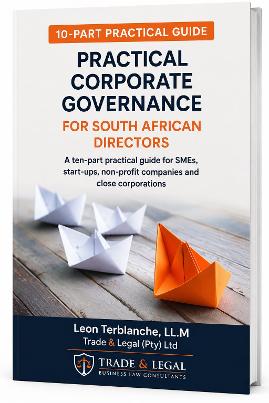
A Practical Guide for South African Directors
Understand Your Duties. Protect Your Business. Become a Better Director.
Being appointed as a company director is more than a title. Understand the legal, financial and governance responsibilities that every South African director should know — explained in clear, practical language.
For directors, entrepreneurs, SMEs, start-ups and non-profit organisations.
Secure checkout • Instant PDF access • Powered by Payhip
Being a Director Comes With Real Responsibilities
Being appointed as a director is not simply a title attached to your name.
You don't need to be a lawyer to be a good director. But you do need to understand what the law expects from you.
Many entrepreneurs become directors when they register a company without receiving any meaningful explanation of their duties. Others have served as directors for years while relying almost entirely on their accountants, auditors or fellow board members for compliance.
That can create unnecessary risk.
As a South African director, you should understand the fundamentals of:
- Directors' duties and responsibilities
- Personal liability
- Conflicts of interest
- Care, skill and diligence
- The Business Judgement Rule
- Board decision-making and record-keeping
- Financial oversight
- Risk and compliance
- Corporate governance
- Ethical and accountable leadership
What's Inside the Guide?
Practical Corporate Governance — Without the Legal Textbook
This 10-part Guide is designed to help directors recognise the issues they should be thinking about, the questions they should be asking and the responsibilities they cannot simply delegate and forget.
1. Directors' Duties and Responsibilities
Understand the legal role and responsibilities you accept when you become a director.
2. The Business Judgement Rule
Learn how informed, rational and properly considered business decisions can help protect directors.
3. Personal Liability
Understand circumstances in which directors may potentially face personal consequences.
4. Conflicts of Interest
Recognise conflicts and understand why proper disclosure and procedure matter.
5. Care, Skill and Diligence
Understand the standard expected of someone occupying the office of director.
6. Effective Board Meetings
Turn board meetings into meaningful governance rather than administrative formalities.
7. Financial Oversight
Understand why directors cannot simply say, "My accountant deals with the finances."
8. Governance and Risk Management
Identify and manage the risks that could affect your organisation.
9. Building a Practical Governance Framework
Create governance processes appropriate to the size and complexity of your organisation.
10. Practical Compliance for South African Businesses
Bring the principles together into a workable approach to better corporate governance.
Who Is This Guide For?
The Guide is designed for people who carry real responsibility for South African businesses and organisations — whether you've just become a director or have occupied the director's chair for years.
Company Directors
Newly appointed or experienced directors who want a practical understanding of the responsibilities that accompany their position.
Entrepreneurs & Business Owners
If you formed the company, own the shares and sit on the board, your responsibilities as a director still matter.
SMEs & Family Businesses
Good governance isn't reserved for JSE-listed companies. Smaller businesses benefit from clear decision-making, accountability and proper records.
Start-Up Founders
Build good governance into your company before investors, lenders, employees and regulatory obligations make things more complicated.
Non-Profit Company Directors
Serving voluntarily or without remuneration does not make corporate governance irrelevant.
Close Corporation Members & Business Managers
Many principles of accountability, financial oversight, risk management and good governance remain highly relevant.
“But My Accountant Handles All of That…”
Your accountant may be excellent. Your lawyer may be excellent. Your company secretary, tax adviser and financial manager may all be excellent.
But you are still the director.
Professional advisers provide advice and specialist assistance. Directors must still exercise their own judgement, oversight and responsibilities.
One of the most important habits of an effective director is therefore not knowing every answer.
It is knowing which questions to ask.
That is precisely what this Guide is intended to help you do.
Why I Wrote This Guide

Leon Terblanche, LL.M
Business Law Consultant | Author
I am a South African business law consultant and the founder of Trade & Legal.
Over the years, I have worked with directors, entrepreneurs, business owners and organisations on corporate, commercial, governance and compliance matters.
Again and again, I encountered the same problem: people establish companies and accept appointments as directors, but very few receive a practical explanation of what being a director actually means.
They may know their businesses extremely well, yet directors' duties and corporate governance can seem buried beneath legislation, court decisions and legal terminology.
I wanted to bridge that gap.
So I wrote the kind of Guide I believe a person should receive when accepting an appointment as a director: practical, understandable, South African, and written for people running businesses rather than studying for a law examination.
My objective is simple: to help South African directors make better-informed decisions, ask better questions and build stronger organisations through better governance.
Leon Terblanche, LL.M
Trade & Legal
Secure checkout • Instant PDF access • Powered by Payhip
Frequently Asked Questions
Practical answers to common questions about directors' duties, corporate governance and the Practical Guide for South African Directors.
Who should read the Practical Guide for South African Directors?
The Guide is intended for South African company directors, entrepreneurs, SME owners, start-up founders, non-profit company directors and others involved in the governance and management of businesses and organisations. It is suitable both for newly appointed directors and experienced directors looking for a practical refresher.
What are the main duties of a company director in South Africa?
South African directors are expected to act in good faith and for a proper purpose, in the best interests of the company, and with the required degree of care, skill and diligence. Directors must also appropriately manage conflicts of interest and comply with applicable statutory and governance requirements. The Guide explains these principles in practical, accessible language.
Can a South African company director be held personally liable?
Yes, personal liability can arise in certain circumstances. The Companies Act 71 of 2008 contains provisions dealing with directors' liability, and the particular facts and conduct of the director will be important. The Guide explains the principles directors should understand and the importance of informed, responsible decision-making.
What is the Business Judgement Rule in South African company law?
The Business Judgement Rule is an important principle relating to the way directors make business decisions. Broadly, it recognises that directors are required to make informed decisions in good faith and in the interests of the company, but are not expected to guarantee that every commercial decision will ultimately succeed. The Guide explains the practical significance of this principle for directors.
Does corporate governance matter for small South African businesses?
Absolutely. Good corporate governance is not reserved for listed companies or large corporations. SMEs, family businesses, start-ups and other organisations can benefit from clear responsibilities, proper decision-making processes, financial oversight, risk management and appropriate record-keeping.
Can directors leave financial and compliance matters to their accountants?
Directors can and should obtain appropriate professional advice, but appointing an accountant, auditor, lawyer or other adviser does not remove a director's own responsibilities. Directors should understand the organisation's financial position, ask appropriate questions and exercise proper oversight.
Is the Guide only for lawyers or people with legal knowledge?
No. The Guide deals with legal and corporate governance principles, but it has deliberately been written in accessible language for business people. You do not need a legal qualification to use it.
I have been a director for years. Will the Guide still be useful?
Yes. Experienced directors can use the Guide as a practical refresher and reference on directors' duties, personal liability, conflicts of interest, board processes, financial oversight, risk management, governance and compliance.
Does the Guide provide legal advice?
No. The Guide provides general educational and informational guidance. It does not constitute legal advice relating to the particular circumstances of an individual director, company or transaction. Professional advice should be obtained where appropriate.
What format is the Guide supplied in?
The Practical Guide for South African Directors is supplied digitally as a PDF, making it easy to keep as a practical reference on your computer, tablet or other compatible device.
How do I purchase and receive the Guide?
Purchase is completed securely through Payhip. After completing your purchase, you will receive digital access to the Guide through the Payhip platform.
Secure checkout • Instant PDF access • Powered by Payhip
A Practical Guide for South African Directors
By Leon Terblanche, LL.M | Trade & Legal
This publication provides general information and educational material and does not constitute legal advice. Professional advice should be obtained where appropriate to your particular circumstances.